



 USA
USA Canada
 UK
UK Italy
Italy Sweden
 Australia

Clear Aligners vs. Braces: What’s Best for Essex County Adults?

If you are an adult thinking about straightening your teeth, the decision usually is not as simple as “braces or clear aligners?”
You may be wondering how either option will fit around work, meetings, commuting, meals, social plans, and everything else already packed into your week. For adults in Belleville and across Essex County, those practical details can matter just as much as how straight your teeth eventually look.
Clear aligners offer a discreet and removable approach. Braces offer a fixed treatment that can handle a wider range of orthodontic problems. Neither is automatically the right choice for everyone.
The better question is which one makes sense for your teeth and your everyday life.
Clear Aligners vs. Braces: The Real Differences
Both braces and clear aligners work by applying controlled forces that gradually move teeth into planned positions. The biggest differences are how those forces are delivered and what treatment feels like day to day.
Traditional braces use brackets attached to the teeth and wires that are adjusted during treatment. Because they stay on your teeth, there is no need to remember to put them back in after eating.
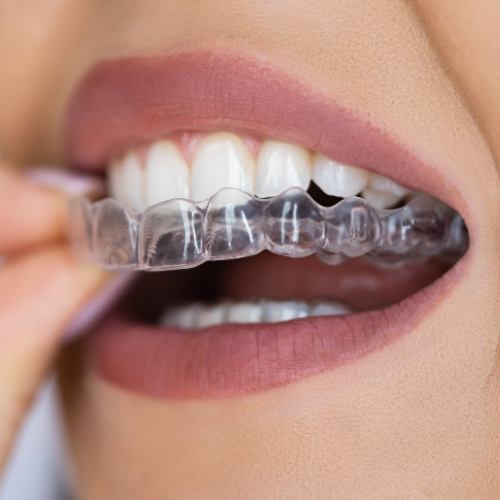
Clear aligners use a planned series of transparent, removable trays. You move through different sets as treatment progresses, with each set designed to guide your teeth closer to their planned positions.
For many adults, that difference changes the entire treatment experience.
Appearance
This is often the first reason adults start looking at invisible aligners.
Clear aligners are transparent and designed to fit closely over your teeth. They are not completely invisible, especially at close range, but they are generally much less noticeable than metal brackets and wires.
That can matter if you regularly attend meetings, work with clients, give presentations, or simply do not want your orthodontic treatment to become one of the first things people notice about you.
Braces are considerably more visible. Ceramic braces can provide a less noticeable alternative to traditional metal braces, but the brackets and wires are still present.
Eating
With braces, certain foods can damage brackets or get caught around the wires. Hard, sticky, and particularly chewy foods may need to be avoided or eaten differently during treatment.
Clear aligners are removable, so you normally take them out before eating. That means there are fewer restrictions on what you can eat.
The tradeoff is discipline. Once you finish eating and clean your teeth, the aligners need to go back in so you continue meeting your prescribed daily wear time.
Cleaning Your Teeth
Brushing and flossing around brackets and wires takes extra care. Food and plaque can collect around orthodontic hardware, which makes consistent oral hygiene particularly important during braces treatment.
With clear aligners, you remove the trays to brush and floss normally. You also need to clean the aligners themselves and avoid putting dirty trays back over freshly cleaned teeth.
Neither option eliminates the need for good oral hygiene. Aligners simply remove some of the physical obstacles that come with fixed braces.
Why Are So Many Adults Interested in Clear Aligners?
For an adult with work and family commitments, orthodontic treatment has to coexist with a life that is already happening.
Someone living in Belleville might work locally, commute into Newark, or spend part of the week traveling into Manhattan. Adding frequent orthodontic appointments to that schedule can become another logistical commitment.
That is one reason discreet orthodontic treatment can be attractive.
They Are Less Noticeable at Work
You may have spent years becoming comfortable in a professional environment and simply prefer not to suddenly show up with visible metal braces.
Clear aligners allow treatment to remain relatively subtle during meetings, interviews, presentations, video calls, and client-facing work.
This is not purely about appearance. For some adults, feeling comfortable with how treatment fits into their professional routine makes it easier to finally start something they have been postponing for years.
You Can Remove Them When Necessary
Being removable is one of the biggest conveniences of clear aligners, but it is also one of their biggest responsibilities.
You can take them out to eat, brush, and floss. Depending on the instructions for your particular treatment plan, there may also be limited situations when having them out briefly is useful.
But removable does not mean optional.
Aligners only work when they are worn according to the prescribed schedule. Someone who regularly forgets to put them back in may find fixed braces easier to manage because braces continue working without relying on daily wear compliance.
They Can Fit a More Flexible Treatment Model
Clear aligner treatment does not always require the same appointment structure as traditional fixed braces.
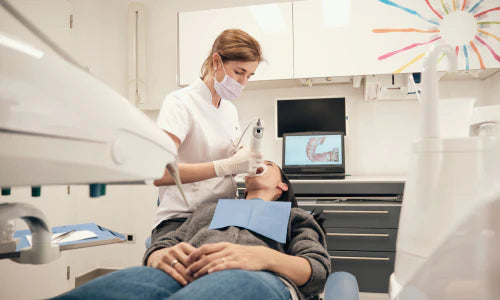
Smileie, for example, offers a scan-based approach where a professional 3D scan is used to capture your teeth before a personalized treatment plan and aligners are created. Progress can then be tracked through the Smileie portal.
For a suitable case, that can mean less disruption to an already busy schedule.
Where Do Braces Still Make More Sense?
This is the part that should not be skipped when comparing clear aligners vs. braces in Belleville, NJ.
Clear aligners are not appropriate for every orthodontic problem.
Modern aligner systems can treat many alignment concerns, but complex tooth movements and certain significant bite problems may require techniques that are more predictable with fixed appliances or specialist orthodontic supervision.
Braces can provide an orthodontist with extensive control over tooth movement because the appliance remains fixed to the teeth throughout treatment.
If your case involves severe crowding, substantial bite correction, teeth requiring complex movement, or another significant orthodontic issue, braces or another clinician-directed treatment approach may be recommended.
That is why choosing the treatment you prefer should come after determining what your teeth actually need.
What About the Cost of Clear Aligners vs. Braces?
Cost is often where the comparison becomes particularly interesting.
An Essex County orthodontic practice currently estimates traditional metal braces at approximately $4,000 to $7,000, while clear aligner treatment through an orthodontic practice can range from approximately $4,500 to $8,500. Actual costs vary based on the provider, case complexity and treatment requirements.
Smileie's current scan-plan pricing follows a different structure.
For daytime treatment, the current price is $749 for a single arch or $899 for dual arch. Nighttime scan plans are currently $849 for a single arch or $1,049 for dual arch.
Those plans include an in-person scan, personalized 3D treatment plan, aligners, two sets of retainers, a whitening kit, free shipping, and progress tracking through the Smileie portal.
Price alone should not determine which orthodontic treatment you choose. A lower-cost treatment is only useful when it is clinically appropriate for your teeth.
If price is an important part of your decision, our guide to clear aligner costs in Belleville, NJ takes a closer look at local orthodontic price ranges, Smileie's current plans, and what is included.
Which Option Fits Your Lifestyle Better?
For many adults, this is where the decision becomes clearer.
If having a discreet and removable treatment is important to you, and your alignment needs can be treated appropriately with aligners, clear aligners may fit more naturally into your routine.
If you would rather have a fixed appliance that does not depend on remembering a wear schedule, braces have an obvious advantage.
There is also the clinical side of the decision. If your orthodontic needs are complex enough that fixed appliances offer greater control, convenience should not override that requirement.
The goal is not to choose the treatment that sounds easiest. It is to choose an appropriate treatment that you can realistically follow through with.
How Does the Smileie Process Work?
If you decide clear aligners sound like the better fit, you do not have to immediately commit to treatment.
The first step is Smileie's free online assessment. This provides an initial indication of whether you may be a suitable candidate for clear aligners.
If you proceed with a scan plan, a professional 3D scan captures a detailed digital model of your teeth. That information is used to develop your personalized treatment plan before your aligners are produced.
You then follow the prescribed aligner schedule and track your progress through the Smileie portal.
If you are already leaning toward aligners and want to know what happens before treatment begins, read What to Expect at Your 3D Dental Scan Appointment in Belleville next. It walks through the appointment itself so you know what to expect before you arrive.
So, Clear Aligners or Braces?
There is no single answer that applies to every Essex County adult.
Clear aligners offer discretion, removability, easier access for brushing and flossing, and a treatment model that can work well around a busy schedule. Braces remain an important option for people whose orthodontic needs require fixed appliances or more complex tooth and bite correction.
Your lifestyle can help you decide what you would prefer. Your teeth determine what is actually appropriate.
Start Your Free Assessment to find out whether Smileie clear aligners may be an option for your smile.
FAQs
1. Are clear aligners better than braces for adults?
It depends on your orthodontic needs and lifestyle. Clear aligners are discreet and removable, while braces may be more appropriate for certain complex tooth movements and bite problems.
2. Can clear aligners fix crowded teeth?
Clear aligners can treat many cases of mild to moderate crowding. More complex crowding may require additional clinical treatment or fixed braces, so individual assessment is important.
3. Are clear aligners really invisible?
Clear aligners are transparent and much less noticeable than traditional metal braces, but they are not completely invisible. They are designed to fit closely over your teeth for a discreet appearance.
4. Are clear aligners cheaper than braces in Belleville, NJ?
Costs vary considerably by treatment model and individual case. Smileie's current scan plans start at $749, while local traditional orthodontic treatment can cost several thousand dollars.
5. How do I know if I qualify for clear aligners?
The first step is to complete Smileie's free online assessment. If you appear suitable for treatment, the next steps can determine the appropriate treatment plan for your teeth.

Latest Blog
-
 Sep 22, 2026
At-Home Impression Kit vs. In-Person 3D Scan: Which Should Encino Residents Choose?
Learn More -

-

-


