




 USA
USA Canada
 UK
UK Italy
Italy Sweden
 Australia

Understanding the Timeline of Clear Aligner Treatment from Start to Finish

If you're considering clear aligner treatment, one of the first questions that probably comes to mind is: How long will it take to straighten my teeth?
The answer isn't always straightforward. Some people complete treatment in just a few months, while others may need a year or longer. The timeline depends on several factors, including the complexity of tooth movement, consistency in wearing aligners, and individual biological differences.
Understanding the full clear aligners timeline can help you set realistic expectations and stay motivated throughout treatment. Let's walk through what happens from the beginning of your journey to the day you reveal your new smile.
A typical clear aligner treatment time ranges from 4 to 18 months, depending on how much tooth movement is needed. The process includes evaluation, treatment planning, wearing a series of custom aligners, periodic progress checks, and long-term retainer use to maintain results.
Why Treatment Timelines Vary
Many people assume that all teeth aligners work on the same schedule. In reality, every smile starts from a different place.
Imagine moving furniture around a room. Rearranging one chair takes a few minutes. Reorganizing the entire room takes considerably longer. Tooth movement works similarly.
Treatment duration depends on:
-
The amount of crowding or spacing
-
Bite issues such as overbite, underbite, or crossbite
-
Whether previous orthodontic treatment has relapsed
-
Age and bone response
-
Compliance with wear instructions
Minor cosmetic corrections may take only a few months, while more complex cases require longer treatment plans.
Stage 1: Initial Evaluation and Treatment Planning
The first stage focuses on understanding your current dental situation.
A dental professional evaluates:
-
Tooth alignment
-
Bite relationship
-
Oral health
-
Existing restorations or dental concerns
Many modern providers use a digital Scan instead of traditional impressions. This creates a detailed 3D model of your teeth, allowing precise treatment planning and visualization of expected tooth movements.
At this stage, specialized software maps out every movement your teeth need to make throughout treatment.
Typical Timeline:
1–2 weeks
Stage 2: Custom Aligner Manufacturing
Once the treatment plan is approved, your aligners are fabricated.
Each aligner in the series is designed to apply carefully controlled pressure that moves teeth incrementally. Rather than making large changes at once, aligners guide teeth through a sequence of small, predictable movements.
This is one reason invisible braces are often viewed as more comfortable than traditional braces. The forces are gradual and distributed across multiple stages.
Typical Timeline:
1–3 weeks
Stage 3: Starting Your First Aligners
Receiving your first set of aligners marks the beginning of active treatment.
Most patients notice:
-
Mild pressure during the first few days
-
Temporary speech adjustments
-
Increased awareness of the aligners
These sensations are usually signs that the aligners are working.
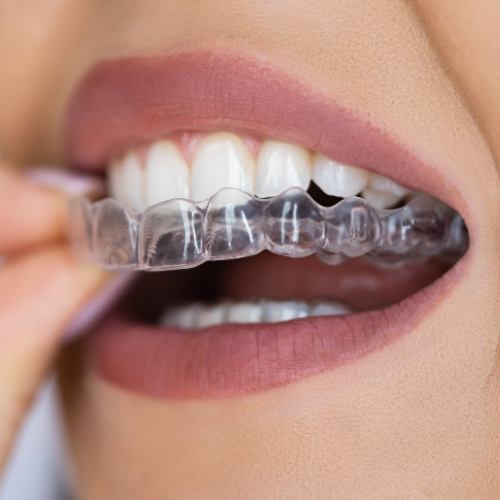
To achieve optimal results, aligners are typically worn for 20–22 hours per day and removed only for eating, drinking anything besides water, and oral hygiene.
Typical Timeline:
First 1–2 weeks of treatment
Stage 4: Progressive Tooth Movement
This is the longest phase of the aligners timeline.
Patients advance through a series of aligners, often changing to a new set every one to two weeks depending on the treatment protocol.
Each new aligner continues moving teeth closer to their final positions.
During this stage, many patients begin noticing:
-
Improved alignment
-
Reduced crowding
-
Closing gaps
-
Better smile symmetry
However, visible changes often occur before treatment is actually complete. Even when teeth appear straighter, important bite corrections may still be underway behind the scenes.
Typical Timeline:
3–15 months
Why Some Teeth Move Faster Than Others
A common misconception is that all teeth move at the same speed.
They do not.
Front teeth often show visible improvements relatively quickly because they have smaller roots and simpler movement requirements. Molars and bite corrections generally require more time because they involve larger teeth and more complex mechanics.
This explains why patients may see cosmetic improvements early but still need several months to complete treatment.
Stage 5: Progress Monitoring
Throughout treatment, progress must be monitored to ensure tooth movements remain on track.
Regular evaluations help identify:
-
Tracking issues
-
Fit concerns
-
Unexpected tooth movement
-
Opportunities for treatment refinement
The exact monitoring process depends on the provider and treatment model.
This stage is an important part of the overall clear aligners treatment time because early intervention can prevent small issues from becoming larger delays.
Typical Timeline:
Throughout treatment
Stage 6: Refinements (If Needed)
Many patients complete treatment exactly as planned. Others may require refinements.
Refinements involve additional aligners that address minor adjustments after the original series is completed.
Think of refinements as the final polishing stage. The major work is done, but small improvements help optimize the final outcome.
Reasons refinements may be recommended include:
-
Teeth responding differently than predicted
-
Minor bite adjustments
-
Fine-tuning alignment
-
Closing residual spaces
Refinements are common and should not be viewed as a treatment failure.
Typical Timeline:
1–4 months
Stage 7: Retention and Maintaining Results
Completing active treatment does not mean your orthodontic journey is over.
Teeth naturally tend to shift throughout life. Without retention, even beautifully aligned teeth can gradually move back toward their original positions.
Retainers help stabilize the bone and surrounding tissues while they adapt to the new tooth positions.
Most orthodontic professionals recommend:
-
Full-time retainer wear initially
-
Transitioning to nighttime wear later
-
Long-term retainer use for lasting results
This stage is often overlooked but is arguably the most important part of maintaining your investment.
Typical Timeline:
Ongoing
Factors That Can Extend Treatment Time
Several factors can lengthen the expected clear aligners timeline.
Not Wearing Aligners Enough
The most common cause of delays is insufficient wear time.
If aligners are designed to work for 22 hours per day but are worn significantly less, teeth may not move as planned.
Missed Aligner Changes
Delaying transitions between aligners can slow progress.
Complex Bite Corrections
Cases involving significant bite discrepancies generally require more treatment time than simple alignment concerns.
Biological Differences
Everyone's body responds differently to orthodontic forces. Some patients naturally experience faster tooth movement than others.
How Long Does Clear Aligner Treatment Usually Take?
While every case is unique, the following ranges provide a general reference:
|
Treatment Type |
Estimated Duration |
|
Minor spacing or crowding |
4–6 months |
|
Moderate alignment issues |
6–12 months |
|
More complex cases |
12–18+ months |
These estimates vary based on individual treatment goals and compliance.
What Happens If You Finish Early?
Occasionally, patients progress slightly faster than anticipated.
However, orthodontic treatment is not simply about making teeth look straight. Proper bite alignment, stability, and long-term function are equally important.
For this reason, treatment should follow the prescribed plan rather than stopping once cosmetic improvements become visible.
The Bigger Picture: Patience Leads to Better Results
One of the most important things to understand about clear aligner treatment is that tooth movement is a biological process.
Teeth are not being pushed through bone overnight. Instead, the body gradually remodels bone around each tooth, allowing safe and controlled movement.
This process takes time, but that time investment helps create results that are both attractive and stable.
When patients understand the complete aligners timeline, they are often more motivated to stay consistent and achieve the best possible outcome.
FAQs
How long does clear aligner treatment usually take?
Most patients complete treatment within 4 to 18 months, depending on the complexity of tooth movement and how consistently aligners are worn.
Can clear aligners work faster than braces?
In some mild to moderate cases, clear aligners may achieve results faster than traditional braces. Treatment speed depends more on case complexity than appliance type.
Do teeth move every day with aligners?
Yes. Aligners apply continuous gentle pressure, allowing gradual tooth movement throughout the day and night when worn correctly.
Why do I need multiple sets of aligners?
Each aligner is designed to create a small amount of movement. Multiple aligners work together sequentially to achieve the final treatment result.
What happens if I don't wear my aligners for 22 hours a day?
Insufficient wear can slow treatment, cause tracking problems, and potentially increase the overall clear aligners treatment time.
Are refinements normal during treatment?
Yes. Refinements are common and often used to fine-tune alignment or bite details after the initial aligner series is completed.
Will my teeth move again after treatment?
They can. Wearing retainers as instructed is essential for maintaining alignment and preventing relapse.

Latest Blog
-
 Sep 22, 2026
At-Home Impression Kit vs. In-Person 3D Scan: Which Should Encino Residents Choose?
Learn More -

-

-


